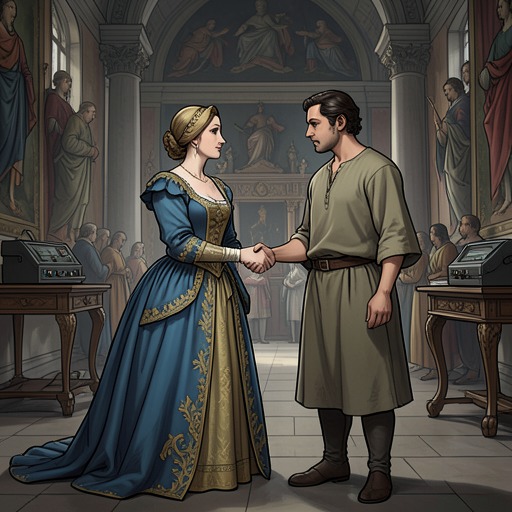
Gwynplaine confronts Lord David Dirry-Moir
The Man Who LaughsGwynplaine confronts Lord David Dirry-Moir at Windsor in a meeting that brings his new aristocratic identity into direct collision with the man he knew as Tom-Jim-Jack. Their recognition revives their former acquaintance, but their competing claims to rank and their connection to Josiana transform it into a contest over equality, authority, and the right to fight. The confrontation ends not in a duel but in an abrupt summons from the Queen, which redirects Gwynplaine from a private dispute into public affairs.
The Unexpected Encounter
The meeting follows Gwynplaine’s disorienting visit to Josiana. Left alone in her rooms beside the tepid bath and deserted couch, he is too overwhelmed by the succession of recent events to make sense of them. Footsteps approach from the opposite side of the gallery from the one through which Josiana had departed. A concealed door beyond a partly open curtain swings wide, and a man enters singing an old French song.
The newcomer wears a magnificent naval uniform covered with gold lace and carries a plumed hat. Gwynplaine recognizes him at once; the man recognizes Gwynplaine in turn. Their simultaneous exclamations establish that each sees the other as someone from a former life: Gwynplaine knows him as Tom-Jim-Jack, while the visitor addresses him as Gwynplaine. The meeting thus begins with familiarity, but neither man is willing to explain why he is there.
Names, Rank, and the Challenge
Lord David Dirry-Moir assumes Gwynplaine has come to Josiana disguised, and frames her interest in him as attraction to both a mountebank and a monster. Gwynplaine refuses to answer his questions, and Lord David likewise declines to explain himself. Their exchange of names makes that refusal a confrontation: Lord David says he is not Tom-Jim-Jack, and Gwynplaine replies that he is not Gwynplaine. Lord David then asserts that he is in his own house.
When Gwynplaine proposes a fight, Lord David distinguishes between the rules of the booth and those of the house. At the Tadcaster Inn, he says, Tom-Jim-Jack could box with Gwynplaine; at Windsor, the difference in their standing changes what weapons are available to them. As a rear-admiral, Lord David says he can fight with a sword only against his equals, whereas at fisticuffs they are equal. He also warns Gwynplaine that he can order him flogged. The threat gives their disagreement a sharper edge: their personal history does not erase the institutional power Lord David now claims over him.
Gwynplaine answers that he is a peer of England and declares himself Lord Clancharlie. Lord David laughs at the claim, treating it as an actor’s assumed part and comparing it to Gwynplaine claiming to be Theseus, Duke of Athens. Gwynplaine nevertheless insists both on his title and on fighting. The scene places his newly asserted hereditary status under immediate pressure from a man who knew him before that status was recognized.
Josiana and the Interrupted Duel
Lord David identifies himself openly as Lord David Dirry-Moir, then says he forgives Gwynplaine because they are both lovers of the same woman. His statement makes Josiana the unspoken center of their contest: Lord David interprets Gwynplaine’s presence in her rooms as an affair of caprice, while Gwynplaine’s claim to be Lord Clancharlie carries the implication that he is the man designated to marry her. The exchange turns the proposed fight into a conflict between two men whose positions toward Josiana are entangled with Gwynplaine’s disputed identity.
Barkilphedro appears and addresses them as the two husbands. His intervention confirms that the meeting has not remained private and gives the rivalry a pointed, public label. A stern gentleman carrying a black wand follows him into the room, bows three times to Gwynplaine, and identifies himself as the Usher of the Black Rod. He says he has come to fetch Gwynplaine in obedience to the Queen’s commands. The scene closes with that summons, not with the sword fight Gwynplaine demanded: court authority interrupts the personal confrontation and carries him toward the next stage of his public recognition.